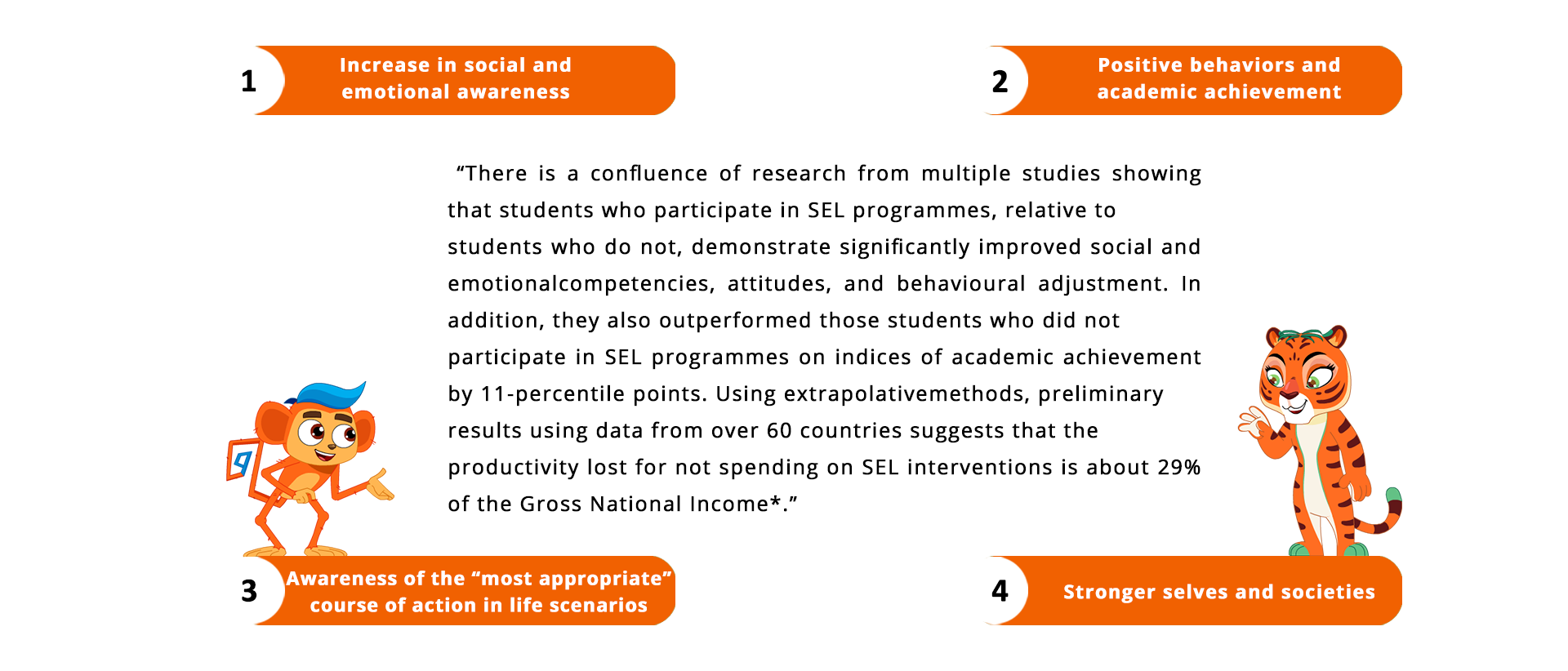
Social and emotional learning (SEL) is defined in the industry as the process of acquiring the competencies, skills/attitudes to recognize and manage emotions, develop caring and concern for others, establish positive relations, make responsible decisions and handle challenging situations.
Early childhood and adolescence constitute periods of maximal sensitivity of the brain to experience and the environment. Enriched social environments and social interactions have a positive effect on brain maturation as well as on cognitive and social, and emotional development at all ages.
A growing body of scientific research indicates that students’ social and emotional competence not only predicts their school success but also predicts a range of important outcomes in late adolescence and adulthood, including high school graduation, postsecondary completion, employment, financial stability, physical health, and overall mental health and well-being. (Diamond, 2014).

The types of skills required to care for and advocate for oneself and others — self-regulation, responsibility, empathy, and discipline, are becoming increasingly central to the work of schools and teachers and increasingly relevant to students' lifelong success.

Learning is facilitated or hindered by the learner's social and emotional experiences, which help guide attention during learning, assist in information encoding and retrieval from memory, and effectively manage the social interactions and relationships that are fundamental to the learning process.

The types of skills required to care for and advocate for oneself and others — self-regulation, responsibility, empathy, and discipline, are becoming increasingly central to the work of schools and teachers and increasingly relevant to students' lifelong success.

Education must pursue a grander goal; an education for human flourishing. Such an education will ideally give equal weightage to knowledge acquisition and use and pay attention to developing pro-social aptitudes to allow the individual to lead a life they have reason to value and cherish.

Higher order social- psychological phenomena (e.g., self-control at the individual level, and empathy, altruism and compassion at the inter-individual level) is the result of a collection of skills hinging on interactions between multiple neurological networks that involve multiple areas of the brain.